
Edinburgh Cancer Centre

Information
The most common side effect of radiotherapy is a skin reaction which can develop during treatment and up to a month after treatment, only occurring within the boundaries of the radiotherapy treatment fields.
The reaction will depend on the dose delivered and the area of the body receiving treatment. All breast cancer patients are classed as high risk and they will be given creams to use during treatment and for two weeks post treatment.
Low risk: receive no creams
Medium risk: Zerobase/Diprobase emollient x 3 day
High risk: Betamethasone 0.1% x 1 day + Zerobase/Diprobase emollient x 2 day
However: Some high risk patients will be given Flamigel RT to use instead of Betamethasone and emollient and will use it three times daily (minimum) throughout treatment and for 2 weeks post radiotherapy.
Typical Skin Reactions Grading – RTOG Skin Score
| Grade | Features |
|---|---|
| RTOG 0 | No change over baseline |
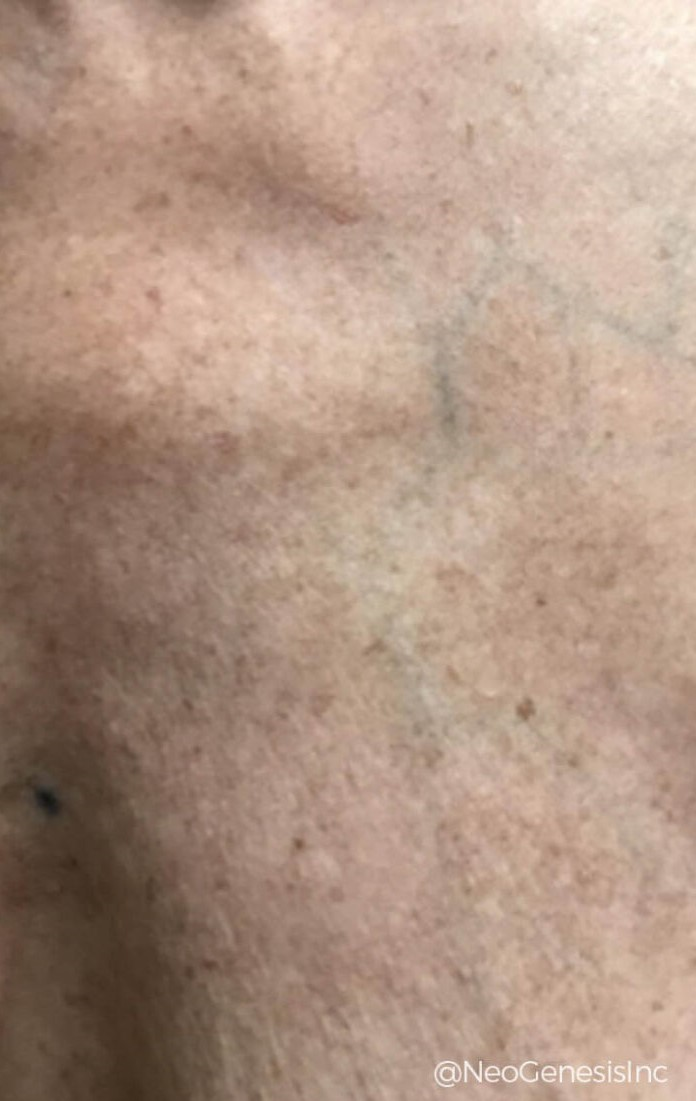
| RTOG 1 | Mild erythema, dry desquamation, decreased sweating |
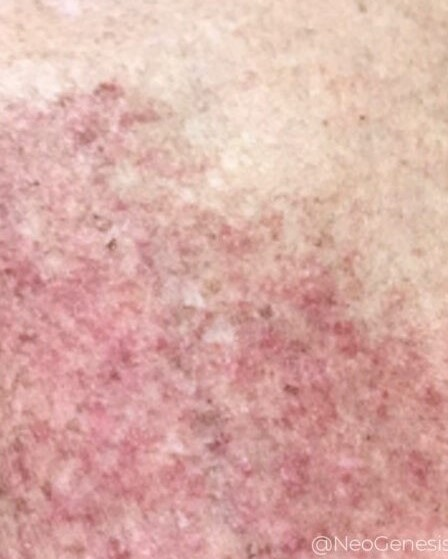
| RTOG 2a | Tender, bright erythema, dry desquamation, rash with itch |
| RTOG 2b | Patchy moist desquamation, moderate erythema, oedema |
| RTOG 3 | Confluent moist desquamation, pitting oedema |
NB Black/brown skin will not demonstrate typical erythema, instead it will be shades of brown, deep black, ebony or purple hues
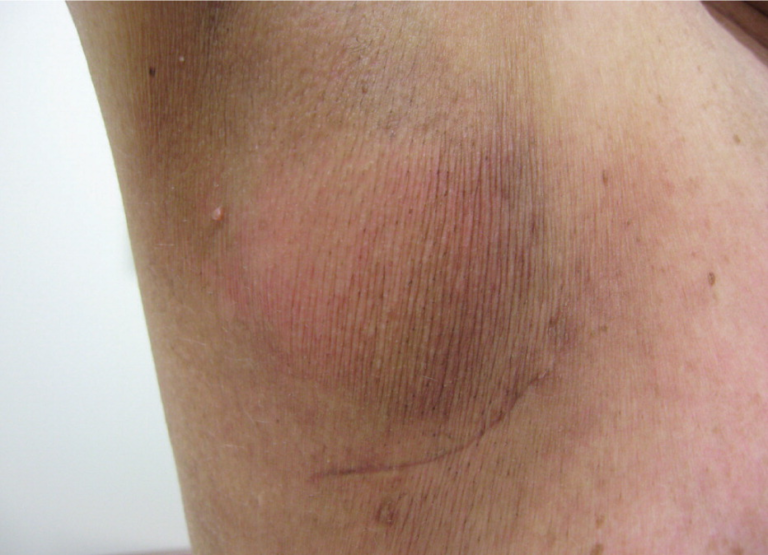
RTOG 1 mild erythema axilla source: https://www.aafp.org/pubs/afp/issues/2010/0815/p381.html
RTOG 1 mild erythema breast source: https://neogenesis.com/concerns/oncology-support/radiation-dermatitis/
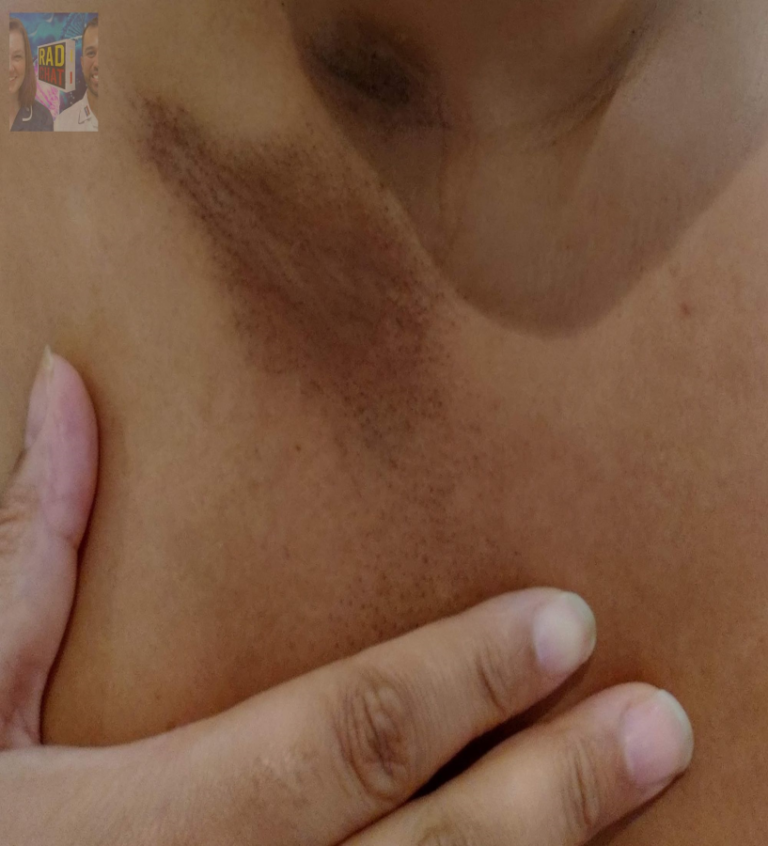
RTOG 2a dry desquamation SCF source: https://www.radchat.co.uk/image-library
RTOG 2a dry desquamation breast source: https://neogenesis.com/concerns/oncology-support/radiation-dermatitis/
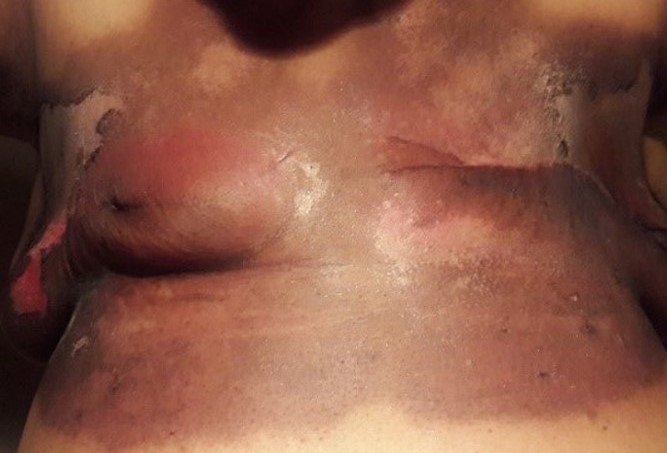
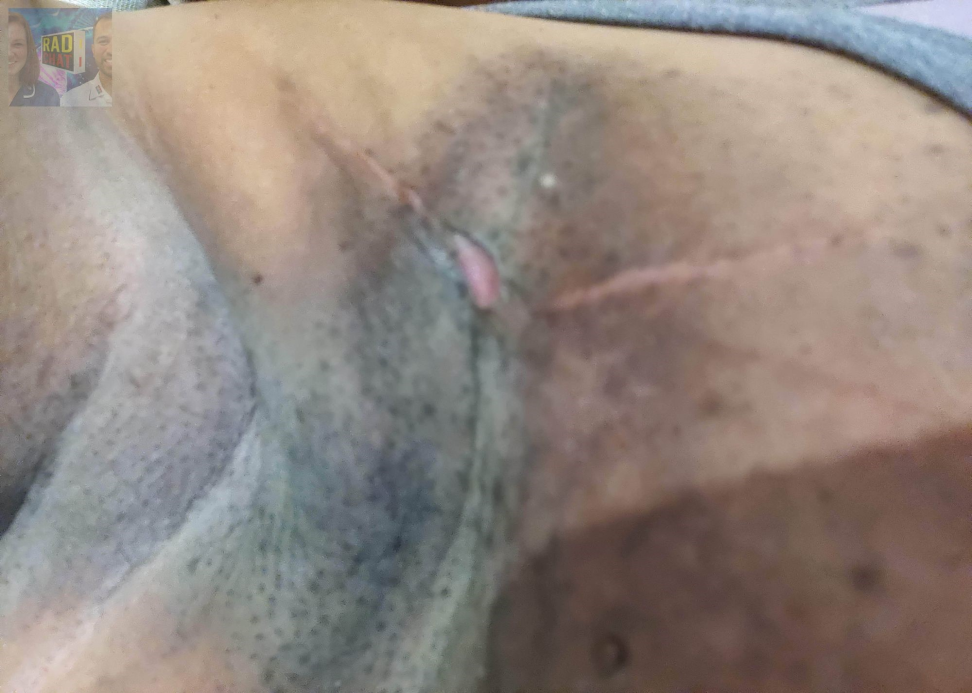
RTOG 2b patchy moist desquamation chest wall source: https://neogenesis.com/concerns/oncology-support/radiation-dermatitis/
RTOG 2b patchy moist desquamation on dark skin source: https://www.radchat.co.uk/image-library
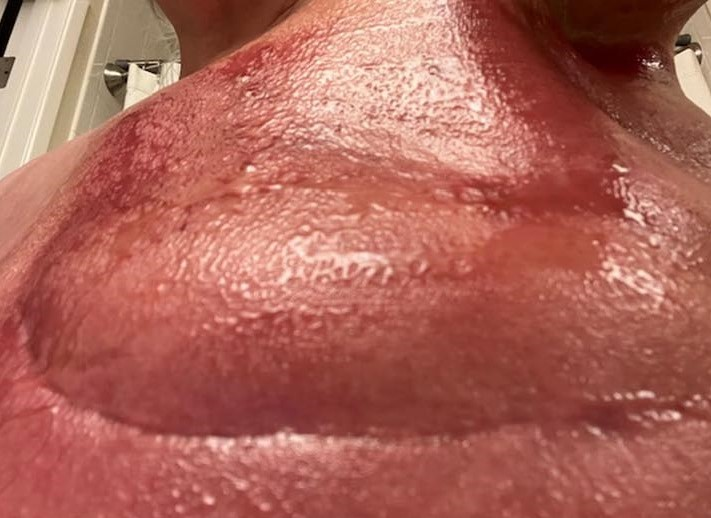
RTOG 3 confluent moist desquamation chest wall source: https://neogenesis.com/concerns/oncology-support/radiation-dermatitis/
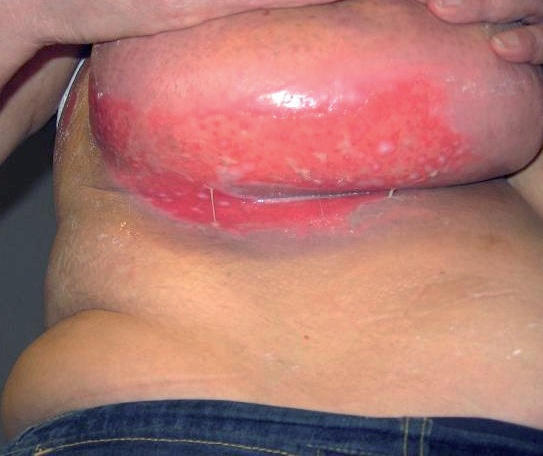
RTOG 3 confluent moist desquamation infra-mammary fold source: https://www.ejoncologynursing.com/article/S1462-3889(14)00057-X/abstract
Anomalies
- Some Radiotherapy skin reactions mimic other conditions eg intertrigo
- Do not prescribe anti-fungals
- Consider radiotherapy treatment reaction in any patient presenting with skin issues within 4 weeks of radiotherapy
- Require different management
- If develops moist desquamation treat as RTOG2b/3 skin reaction
- Photos of typical infra-mammary fold radiotherapy reaction developing in patients prone to sweat rashes receiving breast radiotherapy or post RT
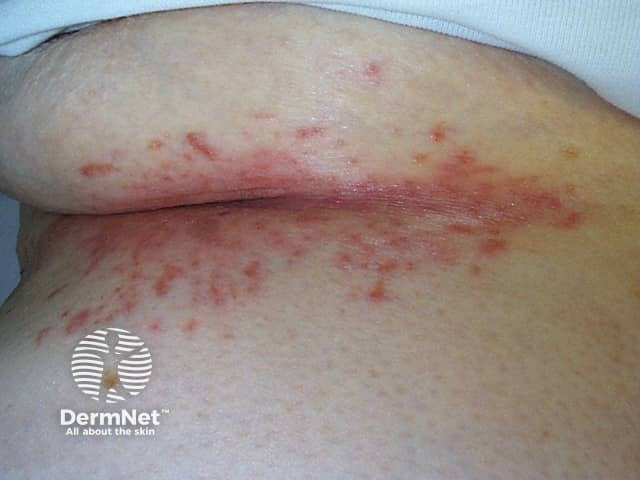 Image 1
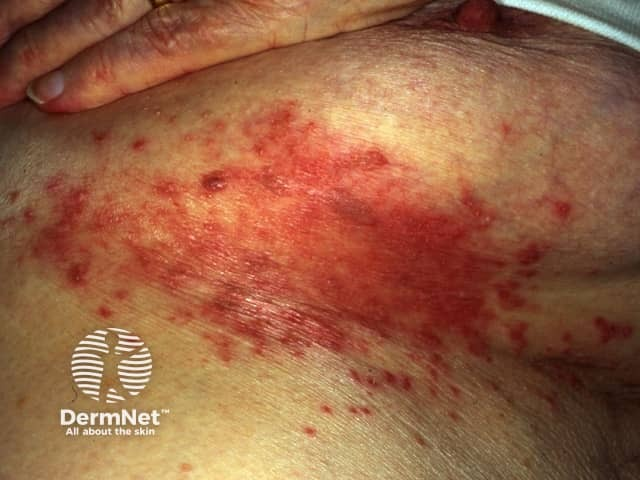 Image 2
Images 1 and 2: Photos courtesy of DermNet
J.C & M.A – 30-01-26
Who to refer:
patients presenting with atypical skin reactions +/- infection, not responding to Flaminal Hydro/Forte and antibiotics
Who not to refer:
patients presenting with typical, expected skin reactions including moist desquamation within radiotherapy field(s)
How to refer:
Self referral (patients only): via Cancer Treatment Helpline: 0800 9177711
OR
Healthcare Professionals and Patients : Breast Radiographers via: Radiotherapy Reception 0131 537 3329
Management of RT Reactions
| Grade | Management |
|---|---|
| RTOG 0/1 | Continue Steroid + emollient/Flamigel RT 3 x day |
| RTOG 2a | Continue Steroid + emollient/Flamigel RT 3 x day |
| RTOG 2b/3 | Switch to Flaminal Hydro/Forte + Kliniderm Border or Mepilex Border dressings to broken areas until resolved – May take 2-4 weeks to improve – Prescribe analgesia as very painful – Antibiotics can be prescribed if systemic symptoms or positive swab result – Steroid/emollient/Flamigel RT can continue to be applied to unbroken skin x 3 day |
Post Surgery Arm Exercises
- In order to regain full use of your arm it is important to do the exercises detailed here. You may feel some stretching and pulling over the operation area while doing your exercises. Do not overdo the movements at first but gradually increase over time until you can use your arms normally.
- How long – keep doing the exercises for around 6 weeks, until you are pain free and your movement has returned to normal.
- Radiotherapy -If you have radiotherapy, you will be required to raise your arm overhead during treatment. It is therefore important to do your exercises in preparation for this. It is also recommended to keep doing your exercises throughout radiotherapy to maintain your flexibility. You may also need to continue to regularly stretch your shoulder area in the longer term after radiotherapy finishes if this area continues to feel stiff.
Exercises Set A:
These exercises (Set A) should be started on the first day after your operation.
They should be performed sitting or standing. We advise that you do these 4 times a day. Each movement should be repeated 5 times, increasing to 8-10 times as you get stronger.
1. Lift your shoulders – relax
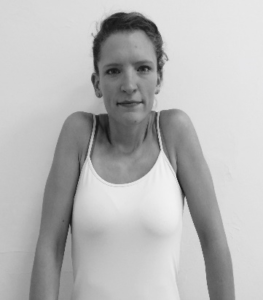 NHS Lothian
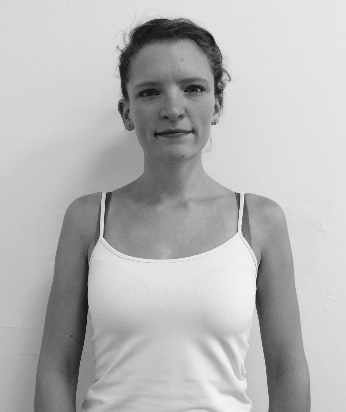 NHS Lothian
2. Pull your shoulders back as if you are trying to squeeze your shoulder blades together at the back
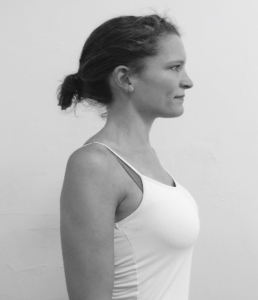 NHS Lothian
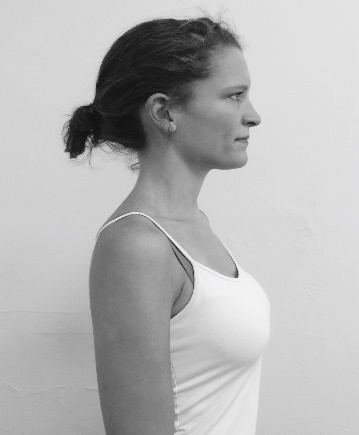 NHS Lothian
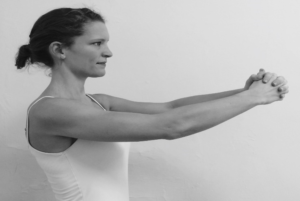
3. Sit or stand with your hands clasped together. Lift your hands up in front of you to shoulder level with your thumbs pointing towards the ceiling. For the first week only raise your arms to 90 degrees (shoulder height).
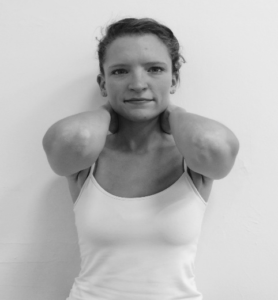
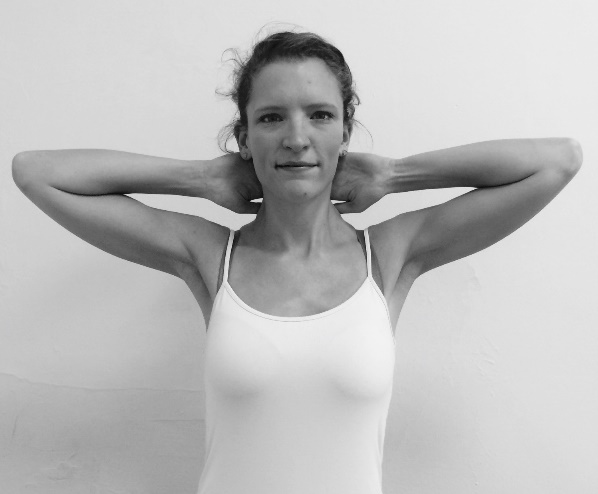
4. Sitting or standing, place your fingers behind your ears. Keeping your head up, stretch your elbows out to the side and then back to the middle.
 NHS Lothian
 NHS Lothian
Exercises Set B:
These exercises are a progression from set A and should be started after one week.
The exercises in set B should be done lying flat on a bed.
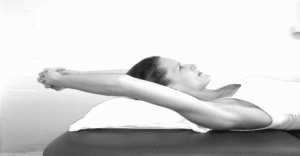
1. Lying on your back with hands clasped. Leading with your thumb, raise your arms slowly overhead keeping them close to your ears. Hold for 2-3 seconds and lower gently. Progress to holding and stretching for 10-20 seconds.
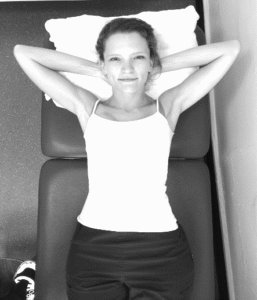
2. Stretch your elbows out to the side – trying to touch the bed with them. Keep them in this position for 2-3 seconds and slowly bring them back together again. Progress this exercise by increasing the hold to 10-20 seconds. Any questions contact WGH Oncology Physiotherapy 0131 537 1923
All exercise images source: Adapted from leaflet After your Breast surgery – Discharge booklet, developed by NHS Lothian.
Society of Radiographers recommends RTOG skin scoring sor.org/getmedia/6484303e-7267-4408-8614-254a9e9a4932/5056_-_sor_design_doc_b_staff_infosheet_-_skin_care_a5_leaflet_llv4_2.pdf