
Information
Recurrent infections are a common presentation. Multiple infections can be normal in children however they often cause concern and time off nursery, school and work.
The vast majority of infections in children are a normal part of developing immunity to common viruses. For those who are thriving and have no warning signs (see below) parents can be reassured that this is a normal part of developing immunity, without any need for investigations or referral.
It is common for healthy children to have up to 12 viral illnesses per year in the first few years of life including respiratory, gastroenteritis, tonsillitis. It is also common for children to get sick from one virus shortly after getting better from a different one, so it can seem like they are sick all the time.
Infections are more common in winter, and among children who attend day care, or live with older siblings.
Children who have never required hospital treatment for an infection are very unlikely to have a clinically significant immunodeficiency.
Please note this is a guideline for recurrent infections, NOT recurrent fevers. Please consider referral if fever lasts over 5 days for urgent review or if concerns about periodic or recurrent fevers to medical paediatrics.
Children presenting with recurrent infections can be separated into:
- no underlying problem – most common
- an underlying problem with the immune system
- an underlying problem with another system
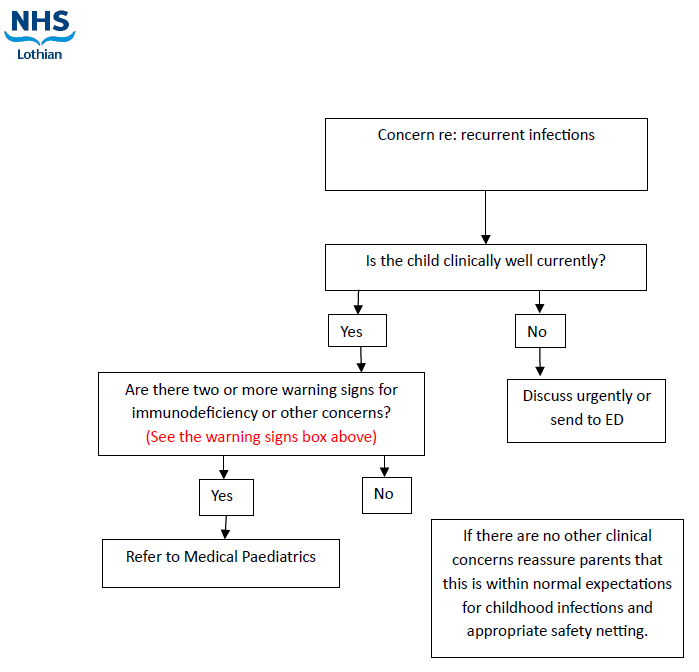
The majority of children have no underlying problem. A small number will have diagnoses including immunodeficiency or chronic conditions such as Cystic Fibrosis which predispose to recurrent infections. If any of the below criteria are met, please refer the child to Medical Paediatrics, or if there is concern the child is acutely unwell, please send to ED. The European Society of Immunodeficiency (ESID) suggests referral if two or more of the following warning signs are present:
Warning signs for immunodeficiency if > 2 are present
1) Four or more new ear infections within 1 year.
2) Two or more serious sinus infections within 1 year.
3) Two or more months of continuous or frequently repeated antibiotics for the same infection or infection site, with poor response.
4) Two or more pneumonias within 1 year.
5) Failure of an infant to gain weight or grow normally (faltering growth)
6) Recurrent, deep skin or organ abscesses.
7) Persistent thrush in mouth or fungal infection on skin (more than 6 months).
8) Need for intravenous antibiotics to clear infections, particularly where oral antibiotics were ineffective or where IV treatment has been required on more than one occasion.
9) Two or more deep-seated infections including septicaemia within 3 years.
10) A family history of primary immunodeficiency.
*Unless otherwise specified, warning signs should be interpreted as occurring within a clinically relevant timeframe (usually the past 12 months), or as part of an ongoing pattern.
Pointers to other conditions associated with recurrent infections:
- Autoimmunity
- History of haematological or oncological disorders
- Dysmorphic features
- Cardiac abnormalities (eg Di George syndrome)
D.M & C.H – 28-05-26
Who to refer:
Please refer any children with two or more warning signs or other concerns for further review. If immediate concerns please discuss urgently as below.
Who not to refer:
- Recurrent UTIs should be referred to Paediatric Renal Service via SciGateway
- Recurrent tonsillitis – see ENT Refhelp page (Recurrent Tonsillitis – RefHelp (nhslothian.scot))
- Recurrent ear infections – see ENT Refhelp page (Ear infections in children – RefHelp)
How to refer:
Please refer all children with warning signs to Medical Paediatrics via SciGateway:
- Royal Hospital for Children and Young People → Medical Paediatrics
- St John’s Hospital → Paediatrics.
Referrals for advice welcome via SciGateway.
Useful details to include in the referral are:
- Concerns
- History of infections – date, type of infection, severity, treatment trialled and response.
- Family history.
- Details of antibiotics given
- Current management.
- Growth: current weight and height, any recent weight loss / growth concern
Referrals that require urgent advice:
RHCYP (Edinburgh):
- In hours: paediatric consultant (Mon –Fri 0900- 1700) via switchboard via bleep 9250
- Out-of-hours: the paediatric registrar via switchboard on 9424.
St John’s hospital (West Lothian):
Discuss with the resident Paediatric Tier 2 bleep holder by phoning SJH switchboard 01506 523000 and asking to Bleep 3564.
Useful Parent Resources:
Fever in children under 5 years :: Healthier Together (what0-18.nhs.uk)
Professional Resources and Links