
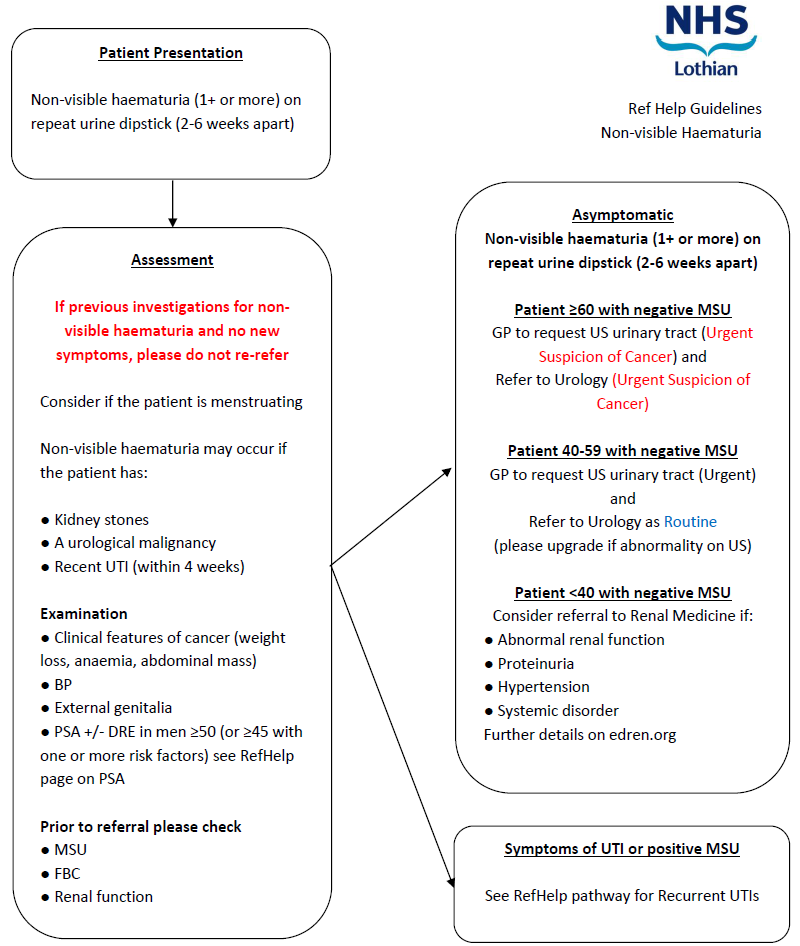
There are many causes of non-visible haematuria. Malignancy is one of them.
There are around 860 new bladder and 1,150 new kidney cancers in Scotland each year. 98% of kidney cancer cases are aged 40 years or over and 99% of bladder cancer cases are aged 45 years or over at the time of diagnosis. Risk factors include:
- Male sex (crude rates of kidney cancer are 2 times higher and bladder 2.3 times higher in males)
- Smoking history
- Family history
The commonest presenting feature of kidney or bladder cancer is visible haematuria. For Visible Haematuria pathway and other presenting features of kidney and bladder cancer see RefHelp page on Visible Haematuria.
H.S & D.M 22-01-26
Who to refer:
- Asymptomatic patient ≥60 with persistent non-visible haematuria (1+ or more) on repeat urine dipstick (between 2-6 weeks apart), with a negative MSSU, refer as Urgent Suspicion of Cancer. GP to also request Ultrasound of Urinary tract (priority Urgent Suspicion of cancer)
- Asymptomatic patients 40-59 with persistent non-visible haematuria (1+ or more) on repeat urine dipstick (between 2-6 weeks apart) refer as Routine. GP to also request US Urinary tract (Priority Urgent)
- Asymptomatic patient <40 consider referral to Renal Medicine if abnormal renal function, proteinuria, hypertension or systemic disorder. Further details on edren.org
Please check MSU, FBC and renal function before referral.
Who not to refer:
- Patients who have been investigated for non-visible haematuria, with no new symptoms
- Patients who have symptoms of UTI or positive MSU. Please see RefHelp pathway for Recurrent UTIs
- Those less than 40 years old unless other symptoms or signs to suggest malignancy or renal tract calculi (see above)
How to refer:
Please send an electronic referral via SCI gateway
Western General Hospital > Urology >Basic Sign Referral
To request a urinary tract USS please select site based on patient location (WGH, RIE, SJH) > Clinical Radiology > LI Radiology Ultrasound > Ultrasound Urinary tract.
See under Urological Cancers section Scottish Referral Guidelines for Suspected Cancer 2025
Online risk calculator for bladder cancer Identify Calculator – BURST Urology | Research Colloborative