Scope of this Guidance
Referrers can refer to the NHS Lothian Clinical Genetics Department for Adults who have a family history of Cystic Fibrosis (CF) or Adults who are the partner of a known adult carrier, where current or future offspring might be affected by CF. Please see Referral Guidelines section below for how to refer without prior testing, under the heading: REFERRAL – STRAIGHT TO GENETICS – NO PRIOR GP TESTING. Please remember however that there is no general pre-conception carrier testing for CF available on the NHS, so Adults being referred without testing in Primary Care, must still fit the referral criteria.
In some instances, GPs may wish to carry out initial testing themselves. This is entirely at the GP’s discretion. The guidance below can be used as a resource in those circumstances. The presence of the guidance is to support those GPs who wish to undertake this testing prior to any referral to Clinical Genetics. It has been prepared because some GPs are already undertaking this work, but until now they have not had any resources to support them. The presence of this guideline does not mean that testing prior to referral is now expected or mandatory, and the presence of this guideline will not be used by Clinical Genetics to reject referrals solely because prior testing has not been carried out.
Clinical Concerns
This guidance does not cover CF testing recommendations for other indications. If a patient has symptoms consistent with a clinical diagnosis of classic CF or CFTR-related disorder, please refer to the appropriate specialist discipline (such as respiratory medicine) for investigations.
Background Information
In the UK, newborn screening for Cystic Fibrosis via the heel prick test on /around Day 5 of life was introduced in 2007 to identify babies with the condition prior to them presenting clinically. Therefore, most diagnoses are now made this way.
Genetics of Cystic Fibrosis
CF is one of the most common autosomal recessive disorders in people of European ancestry and is caused by mutations in the CF Transmembrane Conductance Regulator (CFTR) gene.
The CFTR gene encodes a protein channel which transports chloride and other molecules across epithelial cell membranes. Pathogenic variants in the CFTR gene affect sodium and chloride transport across these cell membranes and result in the production of thickened secretions within airways and ducts.
In the UK, the incidence of CF is 1 in 2500 in Caucasians. The condition is less common in those of Asian and African ancestry. CF is inherited from parents who are known as carriers of CF. Carriers have one normal functioning copy of the CFTR gene and one non-functioning copy. Carriers are themselves generally unaffected. In the UK, around 1 in 25 people are expected to be carriers of CF. When a couple are both CF carriers, there is a 1 in 4 chance that each pregnancy they have together will be affected with CF. There are over 1000 mutations identified within the CFTR gene that can cause CF.
Carrier Testing Pre referral
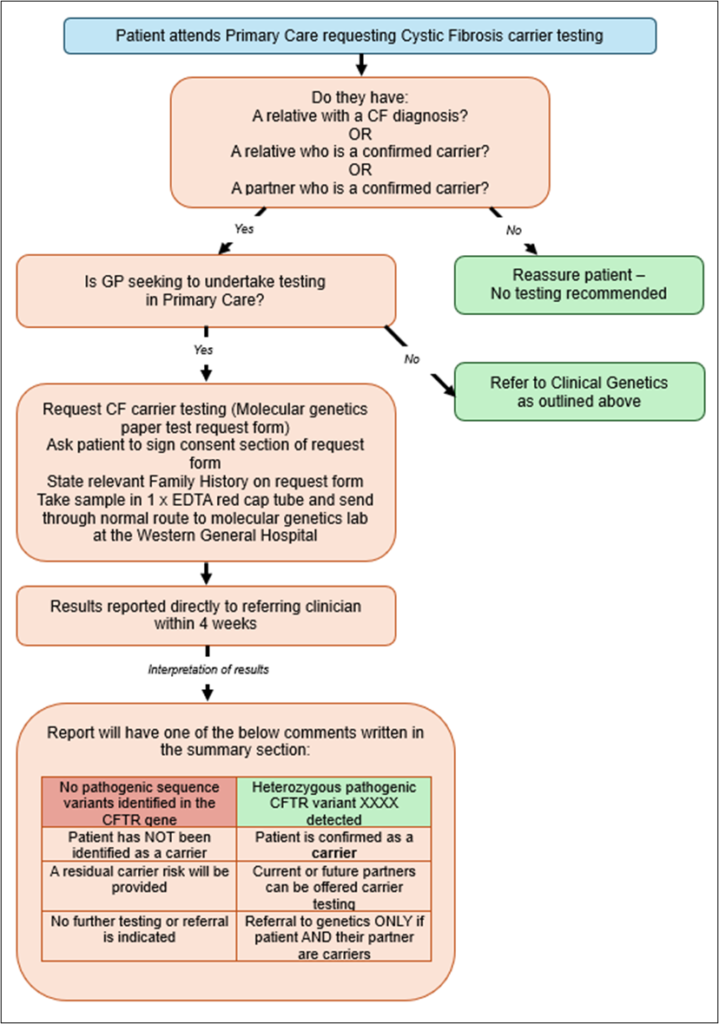
This process is summarised in a flow chart under Primary Care Management.
When a patient requests Cystic Fibrosis carrier testing, it first needs to be established that it is appropriate to test. Testing is only appropriate if the patient has:
- a relative with a CF diagnosis
OR
- a relative who is a confirmed CF carrier
OR
- a partner who is a confirmed CF carrier
It is not appropriate to test if the answer is no to all of these questions. For clarity, there is no general pre-conception carrier testing for CF available on the NHS, for those whose answer does not fall into one of the above categories.
If it is established that testing is appropriate, it is crucial for the laboratory to be provided sufficient information regarding CF in the family of the patient to ensure that the test carried out will identify the familial pathogenic CFTR variant(s).
Please supply the following information:
- If known affected relative has been tested locally please supply the relative’s name, date of birth and their relationship to your patient
- If known affected relative was tested elsewhere in UK please provide as much information as possible (name, date of birth and their relationship to your patient) as well as where testing was done
- Please include the ethnicity of any patients who are not from Northern Europe, so the correct residual carrier risk is given for patients who have a negative test result.
In the absence of this information the lab will test for 50 of the most common variants identified in the Northern European population, which accounts for around 90% of causative mutations, but they will be unable to formally exclude that the patient is a CF carrier if no pathogenic variant is detected.
Ordering Genetic Testing from Primary Care
Genetic Testing cannot be ordered on ICE so the test should be requested as follows:
A blood sample should be taken in a labelled EDTA tube and sent with an accompanying molecular genetic test request form Genetic Test Request Form to the Molecular Genetics laboratory at the Western General Hospital.
To complete the form please fill out:
- Patient details (use label if available)
- Ask patient to read and sign consent section
- Referring clinician’s details.
- Test Request: “Cystic Fibrosis Carrier Test.”
- Clinical Details: If patient has a relative with Cystic Fibrosis or who has been identified as a carrier, provide details of the affected relative (if known) as detailed above.
- The urgent box should be ticked for priority cases, i.e. where the female partner of a couple in question is pregnant. These cases should be discussed with Clinical Genetics (see ‘Who to refer’ section).
Results will be reported in 4 weeks directly to the referring clinician.
For priority cases results will be reported within 2 weeks.
Outcomes and interpretation of results in Primary Care
1. Patient identified as a carrier of CF/CFTR-Related disease gene variant.
- Referral to Clinical Genetics may be appropriate (see Referral Guidelines below)
- CF carrier testing can be offered to the patient’s partner where appropriate for family planning. This can be undertaken by their GP practice, but it should be explained (if not registered at the same practice) that there is no expectation for this work to be carried out in General Practice and their own practice may refer to Clinical Genetics for testing.
- Testing for the familial pathogenic CFTR variant will be available for any relevant family members either via Clinical Genetics referral, or via GP practice if the practice where they are registered is in a position to undertake this work
2. Familial CFTR mutation is known but not detected,
- The report will state that the familial pathogenic variant was not identified in the patient.
- A residual CF carrier risk of the patient will be provided where possible, which takes into consideration the CF risk from the other side of their family without the family history. This is given because of the relatively high incidence of the disorder, and because the testing carried out does not identify 100% of CF-causing mutations.
3. Familial CFTR mutation is not known and no variant is detected.
- The report will state that no pathogenic variants were identified in the CFTR gene.
- The report will state that a test was carried out which detects 90% of the most common mutations in the Northern European population. If the patient is of a different ethnic origin for which there is a known common mutation spectrum, an expected detection rate using the test will be given.
- A residual CF carrier risk of the patient will be provided where possible.
S.H & J.B – 24-7-26
REFERRAL – STRAIGHT TO GENETICS – NO PRIOR GP TESTING.
Who to refer (no prior GP testing):
When a patient requests referral for Cystic Fibrosis carrier testing, it first needs to be established that it is appropriate for Clinical Genetics to test and therefore refer. Referral is only appropriate if the patient has:
- a relative with a CF diagnosis
OR
- a relative who is a confirmed CF carrier
OR
- a partner who is a confirmed CF carrier
Who not to refer (no prior GP testing):
It is not appropriate to refer if the answer is no to all of the questions above. For clarity, there is no general pre-conception carrier testing for CF available on the NHS, for those who answer do not fall into one of the above categories.
REFERRAL – WHEN PRIOR GP TESTING HAS BEEN DONE
Who to refer (after GP testing):
- Couples who have both been identified as carriers and wish to discuss risk for future children. Please mark these referrals as urgent so they are prioritised appropriately if a couple is planning family imminently.
- Couples who have had a child diagnosed with Cystic Fibrosis through Newborn Screening and wish to discuss recurrence risk for future children. Please note, although regional genetics services are copied into newborn screening results, these are not acted on unless a formal referral is made to Clinical Genetics by a Healthcare Professional (e.g. GP, Health Visitor, Paediatrician).
- Pregnant women with a family history or a partner with a family history of CF (please refer both the pregnant woman and their partner if possible). These will be handled as an urgent referral, please send these to us promptly and highlight it is urgent.
Who not to refer (after GP testing):
- Couples where neither patient is identified as a carrier.
- Patients identified as a carrier whose partner is NOT found to be a carrier. Being a carrier of CF is common in the general population (Up to 1 in 20 people) and is not expected to have implications for a person’s health.
- For Patients who are not being referred they can be provided with the following leaflet that has been written by the Clinical Genetics Department: Cystic Fibrosis and Carrier Testing
- Patients where there is a clinical suspicion of Cystic Fibrosis. In this case, advice should be sought from Respiratory Medicine or Gastroenterology.
How to refer (in all instances):
Referrals can be sent via SCI Gateway. The pathway is:
- WESTERN GENERAL HOSPITAL – CLINICAL GENETICS – LI BASIC SIGN REFERRAL OR LI CLINICAL GENETICS
If SCI Gateway not available to the referrer the service accepts referrals via email:
And by post / internal mail:
Referral Administration
SE Scotland Clinical Genetics Service
Western General Hospital
Crewe Road South
Edinburgh
EH4 2XU
If you wish to discuss a referral, please call 0131 537 1116 and ask for the Duty Genetic Counsellor.
Alternatively email Loth.wghclinicalgenetics@nhs.scot
SUMMARY OF MANAGEMENT IN PRIMARY CARE WHERE GP UNDERTAKING TESTING PRIOR TO REFERRAL
Please see the flowchart below for guidance on how to manage patients dependent on their results